

Superchargers as an Element of Engine Forced Induction Systems
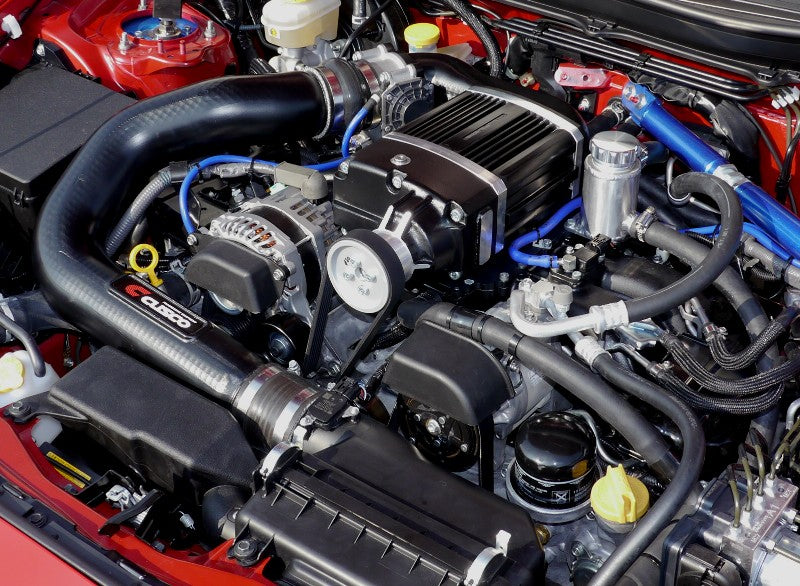
Superchargers are one of the key solutions in forced induction systems, allowing an increase in engine power by supplying a greater volume of air into the combustion chambers. Unlike turbochargers, which utilize exhaust gas energy, superchargers are driven directly by the engine’s crankshaft or via a belt drive. This ensures consistent and predictable boost pressure regardless of exhaust system operating conditions.
In modern engine design, superchargers are used to improve performance without significantly increasing engine displacement. As a result, they remain a popular solution both in street vehicles and automotive tuning projects. In performance configurations, superchargers provide linear power delivery and immediate throttle response, which is critical in dynamic driving conditions.
The supercharger category at ATOMIC-SHOP includes solutions that allow you to choose and purchase a supercharger for various applications — from moderate power gains to high-load performance builds. Products from global brands such as Garrett, Cusco, HKS, and Edelbrock are designed for stable forced induction system operation and an optimal balance between performance and engine longevity.
Supercharger Design and Operating Principle
A supercharger is a mechanical device that compresses air before delivering it into the engine’s intake system. Its operation is based on a mechanical drive that transfers rotational energy from the engine to the compressor mechanism via a pulley and belt. As a result, air is compressed and delivered to the cylinders under increased pressure even at low engine speeds.
There are several main types of superchargers, each with a different operating principle:
- Centrifugal superchargers: operate similarly to the compressor side of a turbocharger but use a mechanical drive. They provide high efficiency at high RPM.
- Twin-screw superchargers: compress air using two intermeshing screws, delivering consistent pressure and high efficiency across a wide range.
- Roots-type superchargers: a classic design that provides strong torque output at low engine speeds.
Engineering Aspects of Supercharger Operation
The primary advantage of a supercharger is the absence of boost delay. Since its operation is directly linked to crankshaft speed, boost pressure is generated instantly. This ensures predictable engine response and precise torque delivery, which is particularly important in performance driving.
At the same time, compressing air increases its temperature. Hot air has lower density, which can negatively affect combustion efficiency. Therefore, most configurations include intercoolers to cool the air before it enters the engine.
Another factor is parasitic loss — a portion of engine power is consumed to drive the supercharger. However, a properly designed forced induction system compensates for this loss through a significant increase in overall power output.
Advantages of Installing a Supercharger
Installing a supercharger offers several important advantages compared to other forced induction systems:
- Linear power delivery: smooth increase in torque without sudden peaks.
- Instant response: no turbo lag ensures immediate throttle reaction.
- Simplified integration: many systems can be installed without major engine modifications.
- Operational stability: performance is independent of exhaust gas temperature.
Applications in Street and Performance Vehicles
In street vehicles, superchargers improve engine flexibility and enhance acceleration across the entire RPM range. This results in more predictable and responsive vehicle behavior in everyday driving conditions.
In performance applications, superchargers are used to achieve maximally consistent power delivery. In disciplines where precise torque control is essential, such as drifting or circuit racing, mechanical forced induction provides stable performance regardless of external conditions.
A specialized solution is twin-charging, where a supercharger operates at low RPM while a turbocharger takes over at higher RPM. This combines the advantages of both systems.
Selection Criteria and System Tuning
When selecting a supercharger, it is important to consider engine specifications, including displacement, design, and allowable load limits. A key factor is the pulley ratio, which determines the rotational speed of the supercharger and the resulting boost level.
For proper system operation, a set of supporting modifications is required:
- Fuel system upgrade: increased injector and fuel pump capacity.
- Bypass valve installation: to stabilize system pressure.
- ECU tuning: optimization of engine parameters for forced induction.
Impact on Engine Performance and Longevity
Superchargers significantly increase engine power and improve dynamic performance. At the same time, the load on engine components increases, requiring the use of high-quality parts and proper system tuning.
Solutions from Garrett, HKS, Edelbrock and other manufacturers ensure stable forced induction operation even under high loads. This allows maintaining engine reliability and achieving predictable performance in all conditions.
The ATOMIC-SHOP range includes superchargers and components that enable projects of any complexity — from daily driving setups to professional motorsport builds.