












Complete Cylinder Head Assembly as the Central Unit for Gas Exchange and Engine Control
A complete cylinder head assembly is one of the most complex and responsible units in an internal combustion engine. It forms the upper part of the combustion chambers, houses the valvetrain, controls the movement of the air-fuel mixture or air through the intake ports, routes exhaust gases through the exhaust ports, and acts as a thermal bridge between the combustion zone, the cooling system, and the oil galleries. In a modern engine, the cylinder head cannot be treated as a simple cover for the block: it is a precision-engineered component whose geometry affects cylinder filling, combustion stability, turbocharger efficiency, temperature control, and powertrain durability.
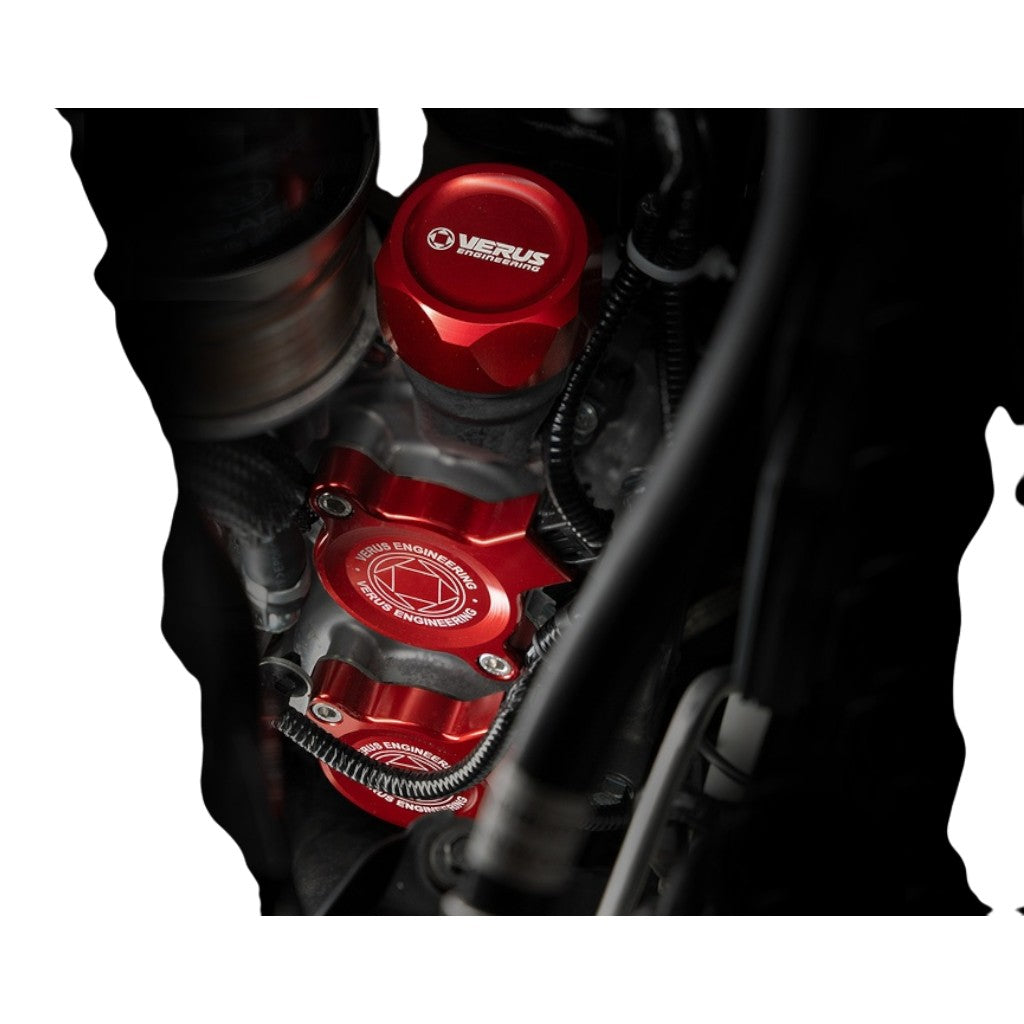
This category includes complete cylinder head assemblies as well as related high-technology components — reinforced front covers for camshaft phasers, protection elements for timing mechanisms, guides, seats, fastening elements, and other parts required for flawless valvetrain operation. This format is especially important for high-load and motorsport projects, where replacing individual basic parts does not always deliver a predictable result without proper refinement and protection around the cylinder head. A comprehensive approach makes it possible to work with an already coordinated configuration, where ports, the valvetrain, external protective elements, and related components are treated as a single integrated system.
For deep engine tuning, track cars, drag builds, and powerful turbocharged engines, every component within the cylinder head structure matters just as much as the piston assembly or engine management system. All airflow that is later converted into torque passes through the cylinder head. If the variable valve timing control units are insufficiently protected, the valves do not match the load level, or heat dissipation operates at the limit, the engine will not be able to realize its potential. In the high-performance segment, products from manufacturers such as AMS Performance and VERUS ENGINEERING are viewed specifically in the context of professional refinement and protection of critical engine zones, where maximum stability under high loads is essential.
Complete Cylinder Head Design and Its Function in Engine Operation
The cylinder head performs several functions at the same time. It closes the cylinders from above, forms part of the combustion chamber, holds the intake and exhaust valves, ensures their precise movement, contains coolant and oil passages, and absorbs significant mechanical and thermal loads. During engine operation, the combustion chamber area is exposed to high pressure, sharp temperature fluctuations, and impact loads from the combustion process. The cylinder head must maintain geometric stability so that the head gasket remains sealed, the valves seat accurately, and the camshafts operate without misalignment.
When the cylinder head is upgraded, it is important to consider not only the internal elements, but also the external components that ensure stable operation of the valvetrain. Valves control the opening and closing of the ports, springs control their return, and reinforced components such as aluminum cam phaser covers from Verus Engineering, manufactured using high-precision CNC machining, reliably protect and seal the variable valve timing control units. In highly modified engines, vibration and extreme temperatures can cause even minor play or microscopic leakage around the cam phaser area to disrupt valve timing algorithms, reduce compression stability, or limit maximum engine speed.
In a standard road car, the cylinder head and its protective covers are designed around a compromise between durability and production cost, which often means thin plastic or fragile cast components. In performance and racing applications, the priorities shift. Port flow capacity, valvetrain strength, resistance to knock-related loads, and reliability of the external perimeter become the main focus. This is why cylinder head development is often treated as part of a complete engine upgrade together with camshafts, valve springs, rigid head studs, the cylinder head gasket, and engine management calibration.
Engineering Principles of Ports, Combustion Chambers, and the Valvetrain
The main technical value of the cylinder head lies in controlling gas flow. Intake ports must deliver air or the air-fuel mixture into the cylinder with minimal losses while maintaining enough flow velocity for efficient filling and mixing. Oversized ports may improve flow at high rpm, but they can reduce engine response in the mid-range. Ports that are too narrow or poorly shaped limit turbocharger or naturally aspirated intake performance by creating unnecessary resistance. For this reason, cylinder head geometry is always a compromise between maximum flow capacity, flow velocity, engine character, and the target rpm range.
The exhaust side of the cylinder head operates in even more demanding thermal conditions. Exhaust gases have high temperature and velocity, and in turbocharged engines they directly affect turbine operation. Poor exhaust port shape can increase backpressure, raise combustion chamber temperature, and reduce exhaust gas evacuation efficiency. In performance configurations, this is especially critical because the engine operates under full load for extended periods, while exhaust temperature remains high for a long time. A properly prepared cylinder head helps stabilize gas exchange and reduce thermal stress on the valves, seats, and turbo system.
The combustion chamber is another key design element. Its shape affects compression ratio, flame travel, knock resistance, and mixture combustion efficiency. In modified engines, it is important that the chamber does not create localized hot spots that can trigger pre-ignition. For turbocharged engines, this is especially important because increased boost pressure raises both thermal and mechanical loads. The cylinder head must work together with the pistons, head gasket, cooling system, and ignition calibration as a single thermodynamic package.
The valvetrain determines how precisely the engine can breathe across different operating conditions. At high rpm, the valves must open and close without valve float, bounce, or loss of spring control. If the springs do not match the camshaft profile, the valve may fail to follow the intended motion curve. This reduces power, disrupts valve timing, and can lead to valve-to-piston contact. Therefore, cylinder head components for serious tuning must be evaluated not only by engine model name, but also by compatibility with engine speed, camshafts, forced induction type, and the planned power level.
Application of Complete Cylinder Head Assemblies in Road, Track, and Turbocharged Cars
In a modified road car, upgrading the cylinder head or installing reinforced components is often used as a way to restore the unit after high mileage, overheating, or a move to a higher power level. For vehicles that remain suitable for daily driving, stable idle, predictable mid-range torque, normal temperature behavior in city traffic, and compatibility with diagnostic systems remain important. In this scenario, cylinder head components should not be excessively radical: the configuration must provide strength without sacrificing the engine’s street drivability.
In track cars, the load on the cylinder head is different. The engine spends long periods in the upper rpm range, repeatedly goes through cycles of hard acceleration and engine braking, and coolant, oil, and exhaust temperatures can remain close to their limits. Here, valvetrain stability, heat dissipation quality, absence of deck surface distortion, and reliability of external timing components become especially important. Cam phaser covers from Verus Engineering, for example, help prevent oil leaks under extreme vibration loads during long sessions.
In drag racing and powerful turbo builds, the cylinder head operates under very high cylinder pressure. In these applications, head-to-block clamping quality, compatibility with reinforced studs, the correct head gasket, valve heat resistance, and the ability of the ports to deliver the required mass airflow are especially important. Even a small restriction in the cylinder head can force the turbocharger to operate in a less efficient range, increase charge air temperature, or raise exhaust backpressure. For high-boost engines, the cylinder head and its components are therefore treated as one of the main factors defining the upper power limit.
In projects based on popular Japanese, European, and American platforms, including sports flat-four and inline engines such as those used in the Subaru BRZ / Toyota GT86 family, cylinder head modernization is an integral part of a complete high-performance engine build. It is combined with forged pistons, reinforced connecting rods, a high-flow fuel system, a larger intercooler, and a performance exhaust system. In such a system, products from AMS Performance and VERUS ENGINEERING are examples of a precision engineering approach to components that operate in an environment of high temperature, high load, and strict material strength requirements.
How to Choose Cylinder Head Components for a Specific Engine
Choosing cylinder head components begins with accurate engine identification. It is necessary to consider not only the make and model of the vehicle, but also the engine code, revision, timing system design, port layout, and compatibility with sensors, manifolds, and the cooling system. Within the same vehicle model, different engine versions may exist, as in the ZN6/ZC6 platform family, and mismatches in mounting points, ports, or auxiliary protective elements can make installation impossible or technically incorrect.
The second criterion is the target power level and how the vehicle will be used. For sporty street builds, it is important to preserve the balance between reliability and engine bay aesthetics by using strong machined covers and reliable seals. For racing configurations or disciplines such as time attack, stability at high rpm and thermal endurance become more important. For drag builds, port flow capacity, valvetrain strength, and compatibility with high boost pressure become critical.
Related components must also be evaluated. The cylinder head must work together with the camshafts, valve springs, retainers, lifters or followers, timing belt or chain, intake manifold, and exhaust manifold. If a part with improved flow capacity is installed while restrictive manifolds or inadequate protection for the variable timing mechanisms remain in place, the expected performance gain and reliability may be minimal. This is why cylinder head component selection must be part of the overall engine build plan, not an isolated decision.
Materials and machining quality require separate attention. Most modern cylinder head components are made from high-strength aluminum alloys, such as anodized aerospace-grade aluminum used in Verus parts, because these materials dissipate heat well, have low weight, and resist deformation. Mating surfaces and mounting areas for protective elements must be perfectly precise to ensure absolute sealing of the oil circuits in the variable valve timing system.
The Impact of the Cylinder Head on Power, Temperature, and Engine Reliability
The cylinder head directly affects how the engine builds power. If the intake ports, valves, custom cam phaser covers, and combustion chamber work together properly, the cylinders fill more efficiently, the mixture burns more consistently, and the engine responds better to ignition, boost, and fuel calibration. In a turbocharged engine, this can mean lower exhaust gas temperature, reduced backpressure, and better turbine efficiency. In a naturally aspirated engine, proper cylinder head development helps maintain airflow at high rpm and broaden the operating range without losing mechanical stability.
Cylinder head reliability is defined not only by material strength, but also by the ability of the assembly to maintain geometry under load. During intensive operation, the head heats unevenly: the exhaust valve area works in significantly harsher conditions than the intake side, while the zones between cylinders and external timing components experience localized thermal and vibration stress. If heat dissipation is insufficient or the protection of moving cam phaser mechanisms is made from poor-quality materials, the risk of deformation, gasket failure, or oil pressure loss in the valve timing control system increases. This is why high-quality reinforced cylinder head components should be viewed as a durability upgrade, not merely visual tuning.
In motorsport, consistency is often more important than peak dyno numbers. The engine must not only produce high power once, but repeat it across runs, practice sessions, and full seasons. Cylinder head components selected correctly for the specific configuration help reduce the risk of valve overheating, loss of sealing, unstable compression, and mechanical failure at high rpm. For a car used on the track or in drag racing, this has practical value: a stable engine is easier to calibrate, simpler to service, and safer to operate near its limits.
Cylinder Head Components as the Basis of a Stable and Balanced Engine
There are no secondary systems in a high-performance engine, but cylinder head components occupy a special place because they connect valvetrain mechanics, combustion thermodynamics, cooling, and gas flow. They define how efficiently the engine breathes, how stable the valvetrain remains, whether the engine can withstand high cylinder pressure, and whether it can preserve durability under intensive use. For tuning and motorsport, these are not just repair parts, but core components that define the character of the entire powertrain.
Correctly selected cylinder head components make it possible to build a balanced engine where the intake, exhaust, turbo system, fuel system, and electronic valve timing control work without internal restrictions. In such a configuration, power increases not because a single component is overloaded, but because the entire system works together. This approach is what separates professional engineering from a random collection of tuning parts. For cars built for fast street use, track driving, time attack, or drag racing, cylinder head components become one of the key decisions that define not only power, but also durability, temperature stability, and the engine’s ability to operate under load without losing control over the combustion process.